

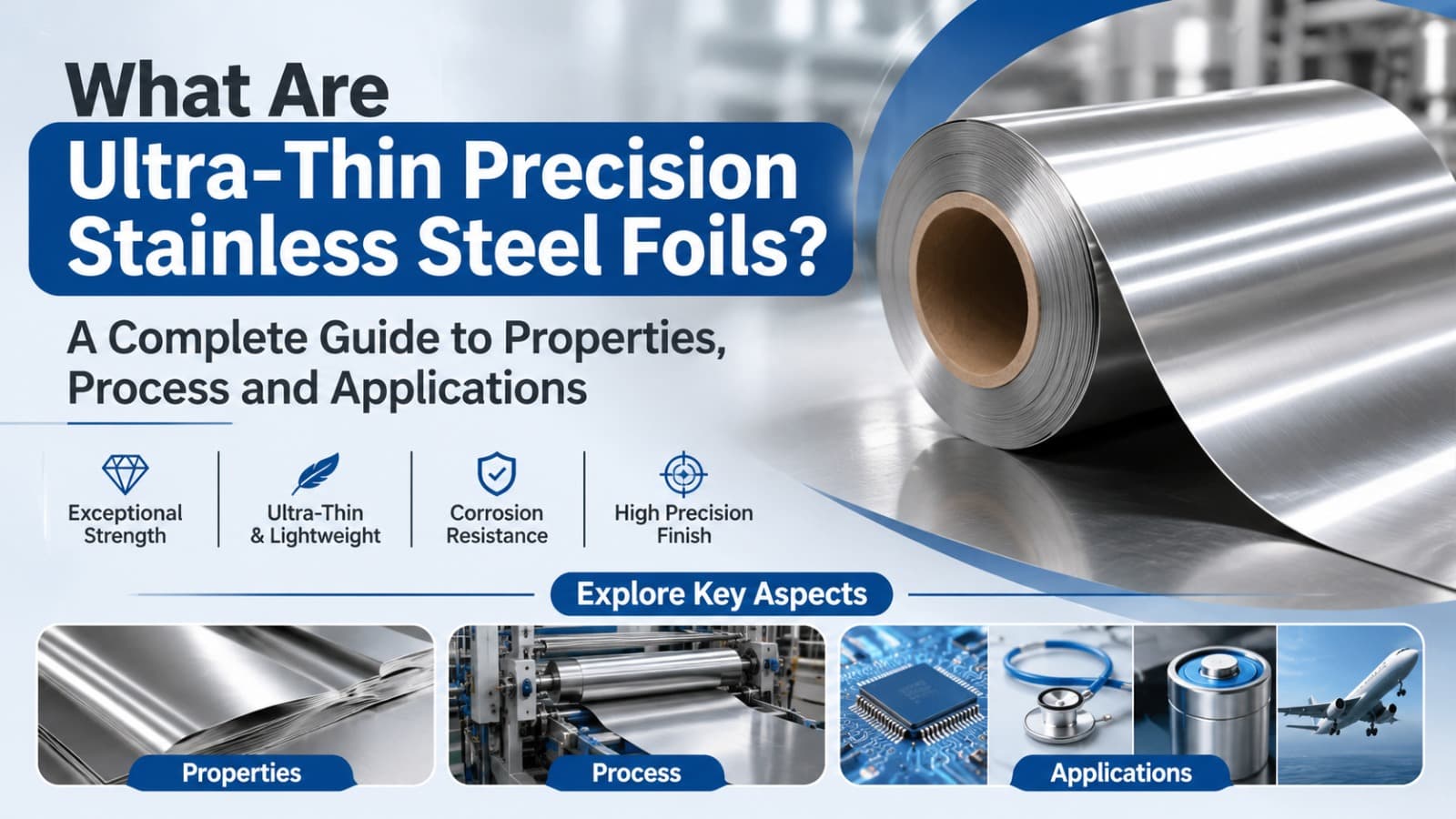
Some of the most important parts inside a car engine, a pressure sensor or a medical device are thinner than a human hair is wide. They are made from ultra-thin stainless steel foil. Because these materials are so thin, they demand a level of manufacturing control that ordinary steel processing simply cannot deliver.
At Jindal Metals & Alloys Limited, ultra-thin precision stainless steel coils and foils, produced down to 0.03 mm, are one of our core specialities. In this guide we explain what stainless steel foil is, how it is made, which properties matter most, and where it is used, so you can specify the right material for your next project.
What Is Stainless Steel Foil?
Stainless steel foil is stainless steel that has been cold rolled to a very small thickness. There is no single universal definition, but in practice the term is used for strip in the range of a few hundredths of a millimetre up to roughly a tenth of a millimetre or a little more. Material in this range behaves differently from standard sheet. It is flexible, easily damaged by rough handling, and extremely sensitive to even tiny variations in thickness.
Foil is usually supplied in coil form, slit to a specified width, so that customers can feed it directly into stamping, forming, etching or laser-cutting lines.
How Ultra-Thin Foil Is Manufactured
Producing foil is a step-by-step reduction process. The key stages are:
1. Raw material selection. Everything starts with the right chemistry. The grade (for example 304, 316 or 430) and the cleanliness of the steel strongly influence how far it can be rolled without cracking or developing surface defects.
2. Cold rolling in multiple passes. The strip passes repeatedly through precision rolling mills. Each pass reduces thickness a little. Cold rolling is done at room temperature, which gives accurate dimensions and a smooth surface, but it also work-hardens the steel, making it harder and less ductile with each pass.
3. Intermediate annealing. To keep the steel rollable, it is heat-treated between passes. Annealing softens the metal and restores ductility. In precision work this is done in controlled atmospheres to protect the surface.
4. Final rolling and temper control. The last passes set the final thickness, surface finish and mechanical properties. Depending on the application, the foil may be supplied soft (annealed) or at a harder temper for spring-like behaviour.
5. Slitting and spooling. The wide coil is slit into narrower coils with clean, burr-controlled edges, then wound with controlled tension so that it unwinds smoothly in your production line.
6. Inspection. Thickness, width, flatness, surface condition and mechanical properties are checked throughout. At these gauges, inspection is not a final step; it is a continuous part of the process.
Why Thickness Control Is Everything
When you work with foil, a variation of a few microns can change how a component behaves. Consider a few examples:
- A gasket layer that is slightly thicker in one area may not compress evenly, which can lead to leakage.
- A sensor diaphragm that varies in thickness will flex differently from one unit to the next, creating inconsistent readings.
- A heat exchanger plate with uneven gauge may form unevenly during stamping, causing rejects.
This is why buyers of precision foil look closely at thickness tolerance, not just nominal thickness. Tight tolerance across the length and width of the coil is a sign of a well-controlled rolling process.
Key Properties to Evaluate
When specifying stainless steel foil, consider the following:
Thickness and tolerance. State the nominal thickness and the acceptable range.
Width and edge condition. Slit width tolerance and edge quality matter for automated feeding and for avoiding burrs in forming.
Flatness. Poor flatness causes problems in stamping, etching and lamination.
Surface finish. Bright finishes are common for precision parts, while other finishes may help with bonding, coating or appearance.
Mechanical properties. Hardness, ultimate tensile strength (UTS), yield strength (YS) and elongation determine how the foil forms and how it behaves in service. A soft, high-elongation foil forms deep shapes more easily, while a hard temper gives springiness.
Corrosion and heat resistance. These depend on the grade. Austenitic grades such as 304 and 316 offer strong corrosion resistance and good formability. Ferritic grades such as 430 are magnetic and cost-effective for milder environments.
Common Grades Used for Foil
The most common grades requested are 304, 316 and 430, supplied against standards such as ASTM, JIS and EN. Grade 304 is a versatile general-purpose choice. Grade 316 adds molybdenum for better resistance to chlorides and chemicals. Grade 430 is a ferritic option where magnetism and lower cost are advantages. Always mention both the grade and the standard in your enquiry, since composition limits differ slightly between standards.
Where Ultra-Thin Stainless Steel Foil Is Used
The range of applications is wide, and it keeps growing as products become smaller and more demanding.
Automotive. Engine gaskets, heat shields, flexible exhaust sections and hose clamps all rely on thin stainless steel.
Defence and aerospace. Honeycomb structures, thermal shielding and lightweight components benefit from the combination of strength, heat resistance and low weight.
Medical and surgical. Hypodermic needles, surgical instruments and device components need clean, corrosion-resistant, dimensionally accurate material.
Electricals and electronics. EMI/RF shielding, contacts, connectors and compact enclosures use thin foil for its conductivity of shielding effect and its stability.
Sensors and IoT. Pressure sensor diaphragms depend on the elasticity and consistency of precision foil.
Energy. Heat exchangers, thermal insulation layers, solar components and energy storage systems use stainless foil for durability and thermal performance.
Handling and Storage Tips
Because foil is delicate, a few practical habits protect it:
- Store coils horizontally or on proper mandrels, away from moisture and contamination.
- Avoid touching the surface with bare hands. Use clean gloves.
- Keep the coil in its protective packaging until it is ready to use.
- Use proper uncoiling equipment with controlled tension to avoid kinks and edge damage.
How to Choose the Right Foil Supplier
A reliable foil supplier should be able to show consistent thickness control, offer a range of grades and tempers, provide material test documentation, and work with you on custom requirements. Certified quality systems such as ISO 9001 give additional confidence that processes are controlled and repeatable.
Conclusion
Ultra-thin precision stainless steel foil is a quiet enabler of modern engineering. From engine gaskets to sensor diaphragms, its performance depends on tight control of thickness, flatness and mechanical properties. Choosing the right grade, temper and supplier from the start saves cost, reduces rejects and improves product reliability.
If you are planning a project that needs precision stainless steel coils or foils down to 0.03 mm, contact Jindal Metals & Alloys Limited. Use the enquiry form on jindalmetal.com or call +91-9323582341, and our team will help you define the right specification.