
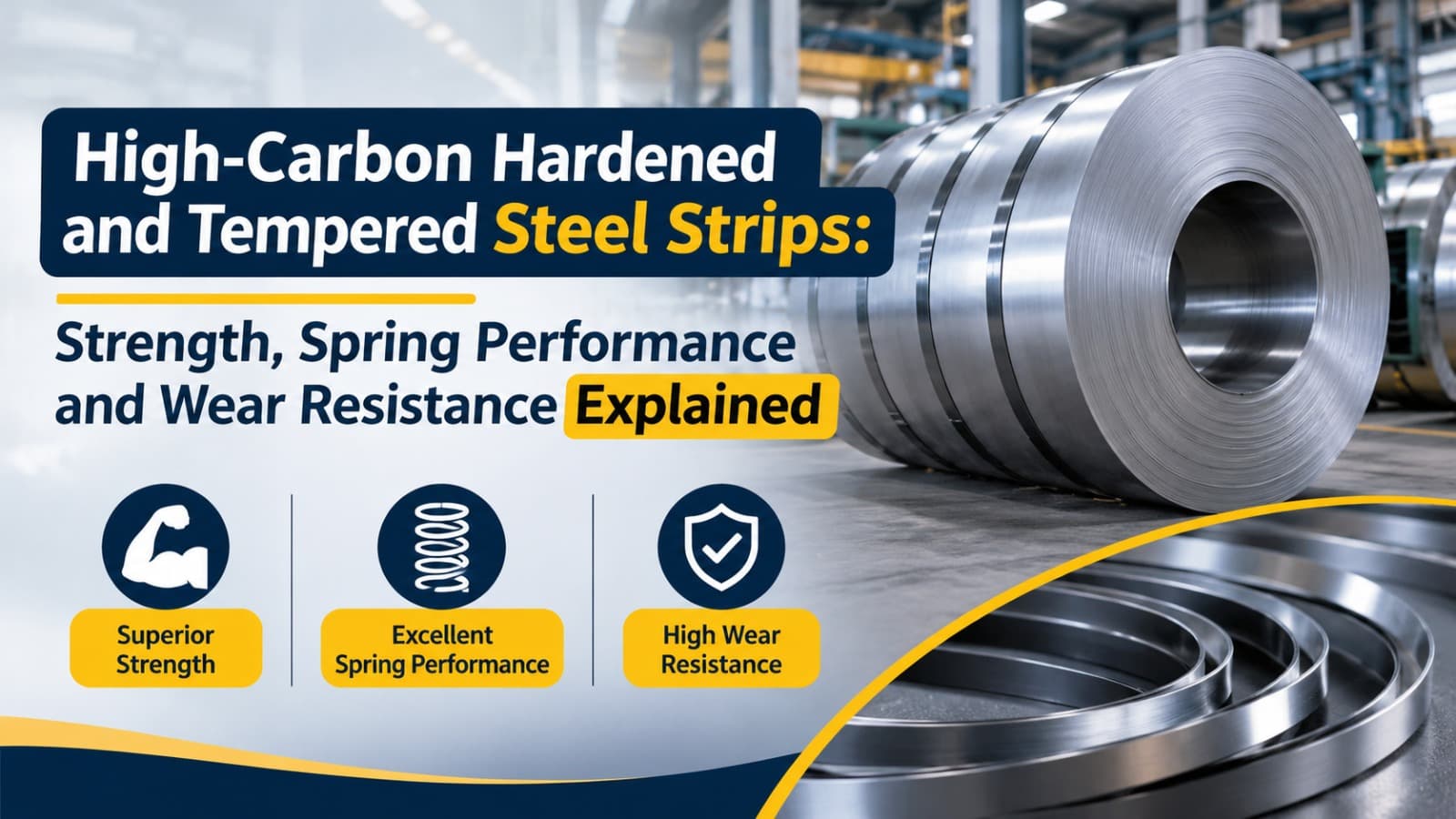
Stainless steel gets most of the attention in metal conversations, but many everyday and industrial products depend on a different material: high-carbon steel that has been hardened and tempered. Think of a saw blade that keeps its edge, a clutch plate that survives constant friction, or a clip that springs back thousands of times without losing shape. These parts need hardness, strength and fatigue resistance far beyond what soft steel can offer.
Jindal Metals & Alloys Limited manufactures high-carbon hardened and tempered steel coils alongside its stainless steel range. This guide explains what these strips are, how they are made, and how to choose the right one for your product.
What Is High-Carbon Steel?
Carbon is the element that gives steel its ability to be hardened. In general, the more carbon the steel contains, the harder it can become after heat treatment. High-carbon steels sit in the upper range of carbon content among carbon steels, which makes them capable of reaching high hardness and strength.
The trade-off is that high-carbon steel is less ductile in its hardened state and, unlike stainless steel, it does not have built-in corrosion resistance. It needs to be protected by oil, coating or plating when the environment demands it. That is why the choice between stainless and high-carbon steel always begins with the question: what matters more, corrosion resistance or hardness and spring performance?
What Does Hardened and Tempered Mean?
These two words describe a two-stage heat treatment that gives the steel its final properties.
Hardening. The strip is heated to a high temperature so that its structure changes, and is then cooled rapidly (quenched). This produces a very hard but brittle structure.
Tempering. The hardened strip is reheated to a lower, carefully controlled temperature and held for a set time. Tempering reduces brittleness and internal stress while keeping most of the hardness. The tempering temperature decides the final balance: a lower temperature keeps more hardness, while a higher one adds toughness and flexibility.
The result is a strip that is strong, hard, tough and springy at the same time, a combination that is hard to achieve in any other way.
How Hardened and Tempered Strips Are Produced
1. Cold rolling to size. The strip is first rolled to the required thickness with tight tolerance, just like precision stainless strip.
2. Continuous hardening. The strip is passed through a furnace in a controlled atmosphere, then quenched, so that it is heated and cooled uniformly along its entire length.
3. Tempering. It then passes through a second heating stage to reach the target hardness and spring properties.
4. Straightening and flatness control. Heat treatment can introduce shape distortion, so the strip is carefully leveled to achieve good flatness and low camber.
5. Surface treatment. Depending on the requirement, the strip may be supplied with a bright, blue-tempered or oiled surface. Protective oil or coatings help prevent rust during storage and transport.
6. Slitting, inspection and packing. Strips are slit to width, tested for hardness and mechanical properties, and packed with protection against moisture.
Key Properties of Hardened and Tempered Steel Strip
High hardness. Measured on scales such as Vickers (HV) or Rockwell (HRC), hardness shows resistance to wear and indentation.
High tensile and yield strength. The strip can carry heavy loads without permanent deformation.
Excellent spring behaviour. A high yield strength relative to tensile strength lets the strip flex and return to shape repeatedly.
Good fatigue resistance. Components that flex millions of times, such as springs and clips, depend on this.
Edge retention and wear resistance. Important for blades, scrapers and friction components.
Dimensional precision. Tight tolerance on thickness and flatness helps with accurate stamping and assembly.
Typical Applications
Automotive and transport. Clutch and brake components, clips, retainers and various spring elements.
Cutting and scraping tools. Blades, knives, saw components, scrapers and doctor blades, where edge retention matters.
Springs and clips. Flat springs, snap rings, retaining clips and washers.
Industrial machinery. Wear plates, shims, guides and components that experience friction or repeated stress.
Agricultural and general engineering. Parts that need strength and toughness under demanding conditions.
High-Carbon Steel vs Stainless Steel: How to Decide
Choose hardened and tempered high-carbon steel when:
- Hardness, wear resistance and edge retention are top priorities
- The part must work as a spring or take repeated flexing
- The environment is dry or the part can be oiled or coated
- Cost per unit of strength is a concern
Choose stainless steel when:
- Corrosion resistance is essential
- The part will see moisture, chemicals or hygiene requirements
- Forming is complex and the part must stay corrosion free without coating
In some products, designers use both materials in different components of the same assembly, picking the best property for each job.
What to Specify When Ordering
To receive the right material, tell your supplier:
- The steel grade or carbon range you need, and the standard
- Thickness and width, with tolerances
- Required hardness (in HV or HRC) and tensile strength
- Surface condition (bright, blue-tempered, oiled or other)
- Flatness and camber requirements
- Quantity, coil size and packaging needs
- End use of the part, so the heat treatment can be matched to it
Handling and Storage Tips
High-carbon steel can rust if left unprotected. A few simple practices help:
- Store coils indoors in a dry place, away from humidity and condensation.
- Keep the protective oil and packaging intact until the coil is used.
- Avoid direct contact with bare hands, since moisture and salts can start corrosion.
- Avoid bending or kinking the strip, which can cause cracks in hard tempers.
Quality Points to Look For in a Supplier
- Uniform hardness across the coil and from coil to coil
- Good flatness and low camber after heat treatment
- Test certificates for mechanical properties
- Consistent surface finish
- Certified quality management systems
Conclusion
Hardened and tempered high-carbon steel strips are the quiet performers behind blades, springs, clips and friction parts. Their blend of strength, hardness and spring behaviour makes them irreplaceable in many designs where stainless steel is not the best fit.