If you buy or specify stainless steel, you will quickly meet a long list of grade numbers. Among them, 304, 316 and 430 are three of the most commonly requested. Each belongs to a different family or has a different chemistry, and choosing the wrong one can mean premature corrosion, forming problems or paying for performance you do not need.
This guide explains the differences in plain language so that you can decide with confidence. It also explains how standards such as ASTM, JIS and EN fit in, since they are part of every correct specification.
First, Understand What Makes Steel Stainless
Steel becomes stainless when it contains enough chromium, generally at least about 10.5 percent. Chromium reacts with oxygen to form a very thin, invisible, self-repairing oxide layer on the surface. This layer is what protects the steel from rusting. Other elements such as nickel, molybdenum and manganese are added to adjust properties like toughness, formability and resistance to specific environments.
Stainless steels are grouped into families. The two that matter for our three grades are:
Austenitic stainless steels (such as 304 and 316). They contain chromium and nickel, are generally non-magnetic in the annealed condition, and have excellent formability and toughness.
Ferritic stainless steels (such as 430). They contain chromium with little or no nickel, are magnetic, and are usually more economical.
Grade 304: The All-Rounder
Grade 304 is the most widely used stainless steel in the world. It typically contains around 18 percent chromium and 8 percent nickel, which is why it is also known as 18/8 stainless.
Strengths
- Good resistance to corrosion in a wide range of everyday environments
- Excellent formability, including deep drawing
- Good weldability
- Easy to clean and hygienic
- Widely available in many forms
Limitations
- Can suffer pitting or crevice corrosion in strong chloride environments, such as seawater exposure
Typical uses. Kitchenware, food processing equipment, general engineering parts, electrical components, architectural trim and many industrial products.
Grade 316: Extra Protection Against Chemicals and Chlorides
Grade 316 is similar to 304 but includes molybdenum, typically around 2 percent, and a slightly higher nickel content. Molybdenum noticeably improves resistance to pitting and crevice corrosion, especially where chlorides are present.
Strengths
- Better corrosion resistance than 304 in chloride and many chemical environments
- Good formability and weldability
- Good performance at elevated temperatures
- Well suited to demanding hygienic uses
Limitations
- Costs more than 304 because of the higher alloy content
Typical uses. Medical and surgical items, chemical and pharmaceutical equipment, marine-exposed components and parts that see harsh cleaning agents.
Grade 430: The Economical Magnetic Option
Grade 430 is a ferritic stainless steel with roughly 16 to 18 percent chromium and very little nickel. Without nickel, it is more affordable and less affected by nickel price swings.
Strengths
- Good corrosion resistance in mild environments
- Magnetic, which is useful for certain applications
- Lower cost
- Good resistance to stress corrosion cracking
- Attractive finish for decorative and appliance use
Limitations
- Lower formability than the austenitic grades, particularly for deep drawing
- Less resistant to aggressive chemical or chloride environments
- Welding needs more care
Typical uses. Appliance panels, decorative trim, some automotive components, kitchen equipment and applications where magnetic response is needed.
Side-by-Side Comparison
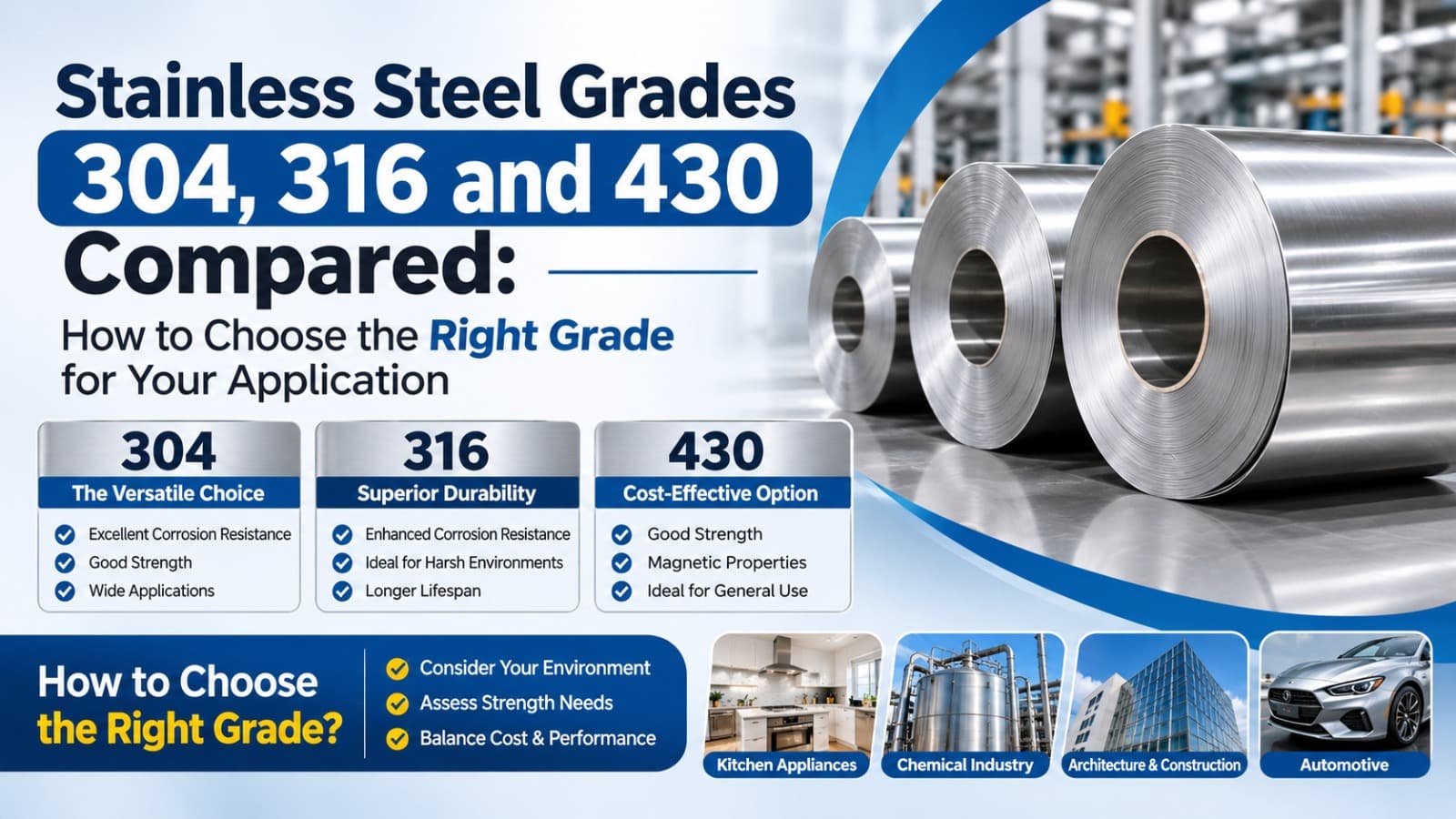
Corrosion resistance: 316 is highest, 304 is good, 430 is moderate.
Formability: 304 and 316 are excellent, 430 is more limited.
Magnetic behaviour: 304 and 316 are non-magnetic when annealed (cold working can make them slightly magnetic), while 430 is magnetic.
Cost: 430 is usually lowest, 304 is mid-range, 316 is highest.
Heat performance: 304 and 316 perform well at elevated temperatures. 430 handles moderate heat but is less suited to extremes.
How to Choose: Practical Questions to Ask
1. What environment will the part live in? Indoors and dry, or exposed to moisture, salt, chemicals or cleaning agents? The harsher the environment, the stronger the case for 316.
2. How complex is the forming? If the part needs deep drawing or tight bends, choose an austenitic grade.
3. Does it need to be magnetic or non-magnetic? For sensors, motors or electronic shielding, this can decide the grade by itself.
4. What is the budget? If the environment is mild, 430 may meet the need at lower cost.
5. What will the part be exposed to in sterilisation or cleaning? Medical and food applications often justify the higher grades.
Why Standards Matter: ASTM, JIS and EN
A grade name alone is not a full specification. The same grade can be defined slightly differently depending on the standard:
- ASTM is widely used in North America and many international contracts.
- JIS is the Japanese Industrial Standard, common in Asian supply chains and electronics.
- EN is the European standard, used throughout Europe and in many export projects.
Chemical composition ranges, mechanical property limits and tolerances can differ between them. When you place an enquiry, always state the grade, the standard, the thickness and width, and the surface finish.
Common Selection Mistakes
- Choosing 304 for a coastal or chemical environment where 316 is needed.
- Paying for 316 when a milder environment would be fine with 304.
- Using 430 for a part that needs deep drawing.
- Assuming all stainless steels are non-magnetic.
- Ordering by grade name only, without stating the standard.
Conclusion
There is no single best stainless steel, only the best one for your application. Grade 304 covers the majority of general needs, 316 steps in where corrosion conditions are tougher, and 430 offers a cost-effective, magnetic choice for milder conditions.
If you would like help selecting a grade, share your application, operating environment and forming requirements with the team at Jindal Metals & Alloys Limited. We supply stainless steel strips, coils and precision foils in grades 304, 316 and 430 against ASTM, JIS and EN standards. Visit jindalmetal.com or call +91-9323582341.