

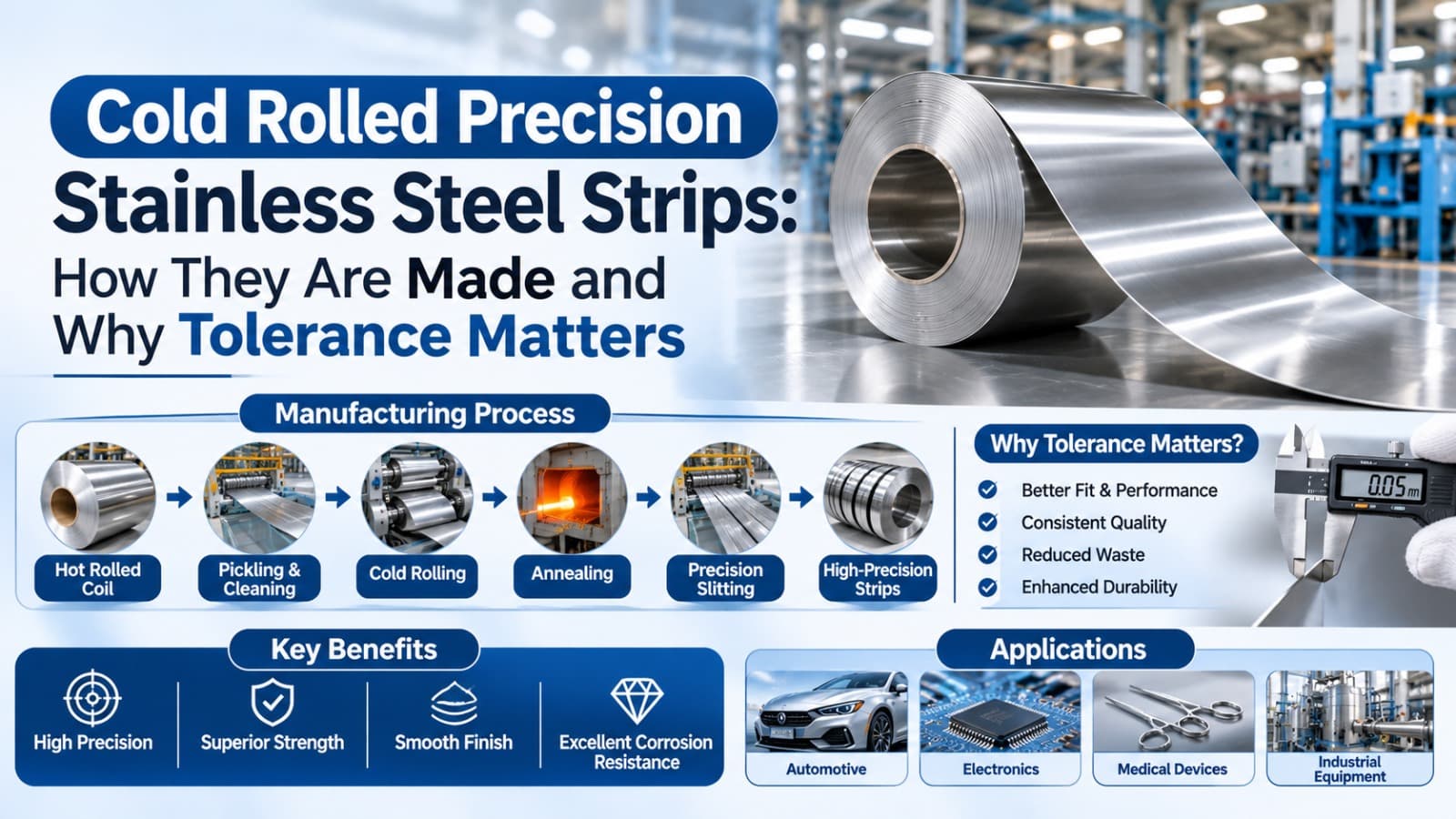
Walk through any factory that stamps, forms or draws metal parts and you will find coils of strip feeding the machines. When parts must be consistent from the first piece to the millionth, the quality of that strip decides how smoothly production runs. Cold rolled precision stainless steel strip is the material of choice for these jobs.
This article explains how cold rolled strip is made, how it differs from hot rolled material, which specifications to define, and which industries use it.
Hot Rolled vs Cold Rolled: What Is the Difference?
Hot rolling happens at high temperatures, well above the point where steel recrystallises. It is efficient for reducing thick slabs into coils, but the result has a rougher surface, a scaled finish and wider thickness tolerance.
Cold rolling starts with hot rolled, pickled coil and reduces it further at or near room temperature. The result is:
- Much tighter thickness tolerance
- A smoother, brighter surface
- Better flatness
- Higher strength through work hardening
- The ability to reach very thin gauges
In short, hot rolling shapes the bulk, and cold rolling delivers the precision.
The Cold Rolling Process Step by Step
1. Hot rolled coil preparation. The incoming coil is annealed and pickled in acid to remove surface scale and oxides, leaving a clean surface for rolling.
2. Cold reduction. The strip passes through rolling mills, where work rolls squeeze it to a smaller thickness. Mills with precise gauge and tension control keep thickness consistent along the length.
3. Annealing. Cold rolling hardens the steel. Annealing in a controlled furnace softens it again, relieves internal stress and restores ductility. For bright finishes, annealing is done in a protective atmosphere to prevent oxidation.
4. Further reduction as needed. Depending on the final gauge, the cycle of rolling and annealing may be repeated.
5. Skin pass or temper rolling. A light final pass improves flatness, refines the surface finish and sets the final mechanical properties.
6. Slitting. The wide coil is cut lengthwise into narrower strips to the exact widths customers need. Edge condition matters here, because burrs or waviness can cause trouble in downstream forming.
7. Inspection and packing. Dimensions, surface, flatness and mechanical properties are verified. Coils are then wrapped and packed to protect them in transit.
Key Benefits of Cold Rolled Precision Strip
Dimensional accuracy. Consistent thickness and width let stamping dies and forming tools run with fewer adjustments and fewer rejects.
Surface quality. A clean, smooth surface suits visible parts, hygienic uses, plating, coating and bonding.
Mechanical performance. Cold working raises strength and hardness, and the temper can be tuned from soft to spring hard.
Flatness and shape. Good flatness means smooth feeding through progressive dies and accurate blanking.
Efficiency. When the material is consistent, your production line wastes less time and less metal.
Specifications You Should Define
To get exactly what you need, provide the following in your enquiry:
- Standard and grade (for example ASTM, JIS or EN; 304, 316 or 430)
- Thickness range (minimum and maximum) and tolerance
- Width range and slit tolerance
- Quantity in kilograms or tonnes
- Surface finish (bright, matte or as required)
- Mechanical properties: hardness, UTS, YS and elongation
- End use, which helps the manufacturer recommend the best temper
- Any special requirements, such as coil ID, outer diameter, edge type or packaging
The more precisely you describe your needs, the faster and more accurately a quote can be prepared.
Understanding Temper and Mechanical Properties
The temper of strip is its hardness condition. A soft or annealed temper has high elongation and is ideal for deep drawing and complex forming. Harder tempers have higher tensile and yield strength and are chosen for springs, clips and parts that need to hold their shape. The right choice depends on how much forming your part needs and how much strength it needs in service.
Applications of Cold Rolled Precision Strip
Automotive. Hose clamps, gaskets, heat shields, brackets and trim.
Electricals and electronics. Contacts, terminals, connectors, enclosures and shielding.
Kitchenware and food processing. Utensils, appliance components and equipment parts that need a clean, hygienic surface.
Medical and surgical. Instrument components and device parts requiring corrosion resistance and precision.
Industrial and energy. Heat exchanger plates, thermal components and fabricated parts.
Quality Checks That Matter
When evaluating a strip supplier, ask about:
- Thickness measurement methods and tolerance consistency
- Flatness and camber control
- Surface inspection practices
- Mechanical testing and test certificates
- Traceability from heat number to finished coil
- Quality management certification, such as ISO 9001
Tips for Getting the Best Results
- Share a drawing or sample of your part when possible, so the supplier can recommend the right temper.
- Discuss annual volume, because it affects coil sizes and delivery planning.
- Check that the coil dimensions suit your uncoiler and feeding line.
- Store coils in a dry, clean area and keep packaging intact until use.
Conclusion
Cold rolled precision stainless steel strip is a foundation material for manufacturers who value consistency. Its accurate dimensions, smooth surface and tunable properties make production smoother and finished parts more reliable.
Jindal Metals & Alloys Limited produces precision stainless steel strips and coils to your specified grade, standard, thickness, width and properties. Send us your requirement through the enquiry form at jindalmetal.com or call +91-9323582341.